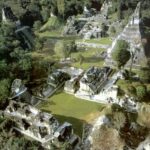
Main structures and architectural complexes of Tikal
22 December, 2025

Tikal National Park is home to one of the most important urban centers of the ancient Maya civilization and represents a cultural and natural heritage site of exceptional value for Guatemala and the world.
Visiting Tikal is not only about walking among ancient stone structures; it is about entering a city that, for centuries, was a powerful political, religious, and economic center of the Maya world, now protected by the tropical rainforest of Petén.
A brief history of Tikal
The earliest human settlements in the Tikal area date back to the Middle Preclassic period (approximately the 4th century BC), although the city reached its greatest splendor during the Classic Maya period (AD 200–900).
At its peak, Tikal was a metropolis with an estimated population of tens of thousands of inhabitants, characterized by:
- Large pyramidal temples
- Vast ceremonial plazas
- Residential, administrative, and religious complexes
- Intense political and ritual activity
By the end of the 9th century, the city was gradually abandoned, likely due to a combination of environmental pressures, climate changes, internal conflicts, and social transformations.
For centuries, the jungle covered much of the structures, naturally preserving them until their modern scientific study.
Although local communities were always aware of the site’s existence, systematic archaeological research was carried out mainly during the 20th century, most notably through the Tikal Project led by the University of Pennsylvania between the 1950s and 1970s.
Due to its historical, architectural, and natural significance, Tikal was declared a UNESCO World Heritage Site in 1979 under the mixed category of cultural and natural heritage.